fintech IRELAND
email / social
  • Home
  • Fintech Authorisations
  • Fintech Education & Training
  • Fintech Ireland Map
    • Fintech Survey
  • Events
    • Summit
    • Events-Archive
  • Fintech Hub
  • News-Insights
    • Consultations
    • News Page Back Up
  • Careers
  • RegTech
  • CRYPTO
  • Fundraising
  • Brexit & Ireland
  • About
    • Fintech Family Network
  • Get Involved

NEWS: New Payments Institution authorised in Ireland - SegPay (September 2020)

30/9/2020

0 Comments

 
Picture
** Another regulated payments institution for Ireland **

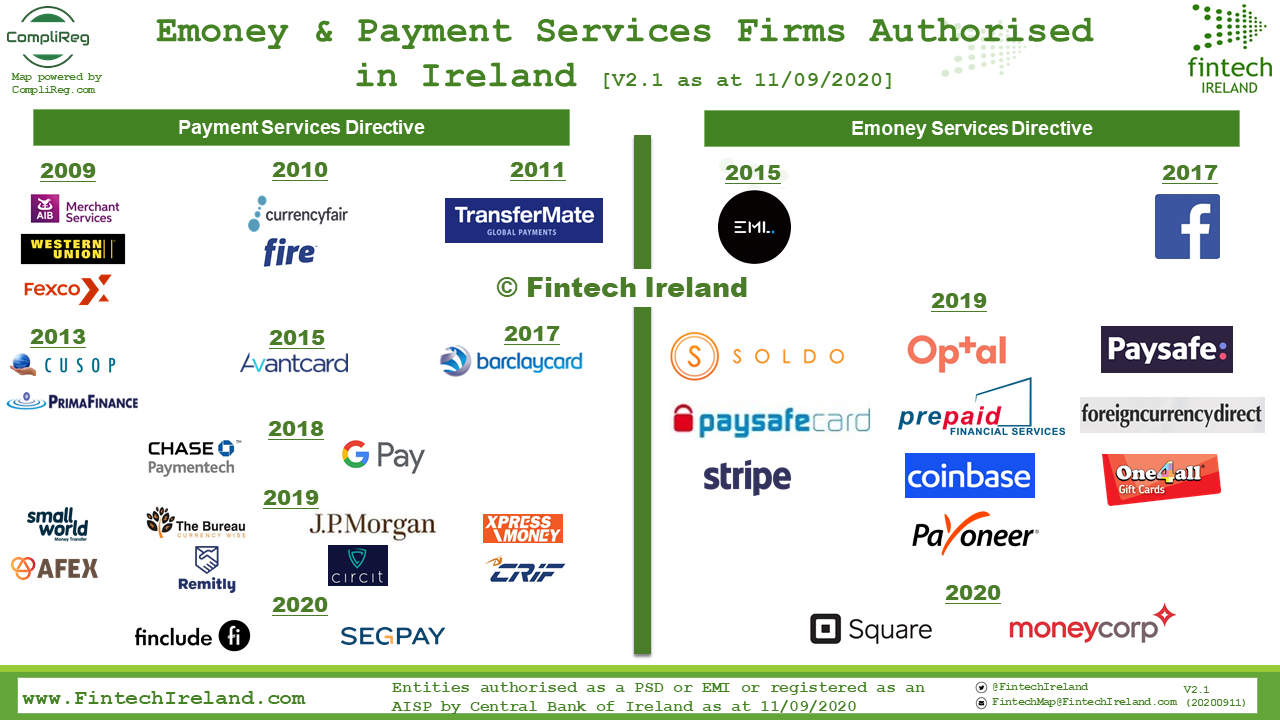
It has been an interesting number of months since Fintech Ireland published the last 'Emoney & Payment Services Firms Authorised in Ireland' Map back on 1 July 2020 (thanks to CompliReg). At that date we only had 3 emoney/payments firms authorised in Ireland in 2020.

On 11 September 2020, Ireland welcomed another #brexit hedge firm, this one being Segpay Ireland, authorised as payments institution for 3(c). Execution of credit transfers, including standing orders and (5) Issuing of payment instruments and/or acquiring of payment transactions.

“We’ve spent countless hours preparing for Brexit because it was so important to have our merchants remain on solid ground when Brexit officially goes into motion,” said Cathy Beardsley, Segpay President & CEO. Ailish Penston is Country Manager. 

Welcome to Ireland SegPay and also the many others in the Central Bank of Ireland authorisation pipeline!

Read more about SegPay here.

Those firms in the above map which are indigenous to Ireland also appear on our bigger Fintech Ireland Map version 3.0 which you can find here. If you think you should be on the Fintech Ireland Map, complete our Survey.

If you are looking to get authorised in Ireland as an emoney or payments firm, see these Authorisation Guides.
0 Comments

New E-Money Institutions authorised in Ireland - Moneycorp & Square (June 2020)

1/7/2020

0 Comments

 
Picture
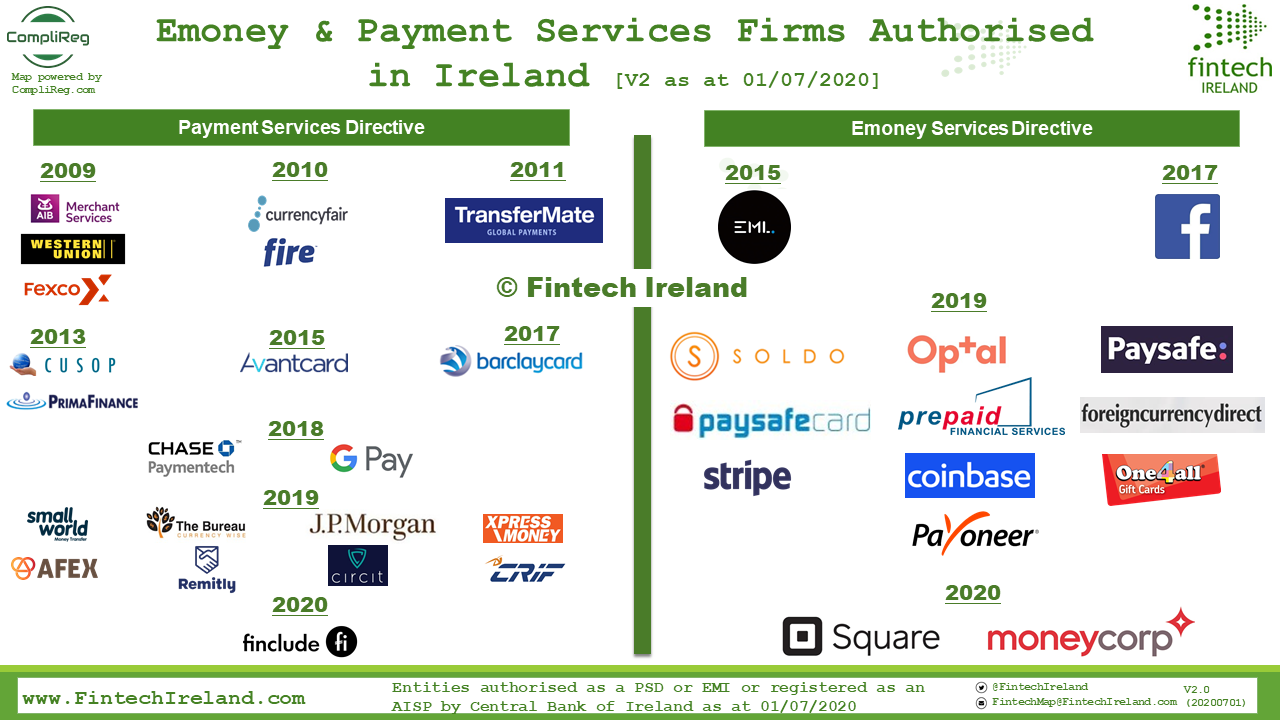
CompliReg, which powers the Official Fintech Ireland Map 2020 and the Regulated Fintech Ireland Map has written a blog on the recent authorisations of two fintech firms, Squareup International Limited  ("Square") and MoneyCorp. 

In addition to issuing emoney, Square is authorised to provide payment services number 3b (execution of payment transactions through a payment card or a similar device) and number 5 (issuing of payment instruments and/or acquiring of payment transactions).  

Read the blog here 


Those firms in the above map which are indigenous to Ireland also appear on our bigger Fintech Ireland Map version 3.0 which you can find here. 

If you are looking to get authorised in Ireland as an emoney or payments firm, see these Authorisation Guides. 

0 Comments

Brexit & "Regulatory Arbitrage" and the fintech opportunities for Ireland

20/3/2017

0 Comments

 
Picture
Thanks NewsTalk for radio interview this morning on Brexit & "Regulatory Arbitrage" and the fintech opportunities for Ireland. LISTEN TO AUDIO HERE

Background to this piece, thanks to Donal O'Donovan, is Irish and international media over the past few weeks reporting claims that Ireland is becoming a victim of 'regulatory arbitrage' and 'dangerous competition' for 'Brexit Spoils'.  The Irish Minister for State (Financial Services), Eoghan Murphy has been moved to raise concerns with Valdis Dombrovskis, the EU financial services commissioner.  Murphy informed Reuters that “We are hearing from various sources that companies are being offered certain incentives, that they are offering a back door to the single market, without the requirement to have capital to back up their entities in the European Union.”   In a sign that there may be more to come, the Financial Times reported that "against the background of the risk to stability in the European financial system. The heads of Esma and EIOPA, two key EU financial regulatory agencies, are believed to have raised similar concerns [to those of Eoghan Murphy] in recent days." [source FT, 14/03/2017 - Irish complain about rivals in Brexit race for London’s business].  

This post is also carried at LinkedIN - https://www.linkedin.com/hp/update/6249557917670862848 

0 Comments

Fintech - Why 2017 could be the year the 'robo-advisors' finally come to town: Peter Oakes, Fintech Ireland

5/1/2017

1 Comment

 
Picture
PDF format here  

Conor McMahon, Reporter at Fora talks to Peter Oakes, Founder of Fintech Ireland about how automated financial advice is expected to shake up the wealth management sector

SO-CALLED ‘ROBO-ADVISORS’ already manage billions of dollars in the US, but they have yet to make their way to these shores.

Traditional wealth management has been largely untouched by the march of digital on this side of the Atlantic, and the sector is still overwhelmingly burdened by paper and admin work.

But not for much longer. Automated financial advice is already making waves in the UK, and Ireland could see a surge of robo-advice firms setting up shop in a bid to access investors in Europe.

Fora spoke to fintech expert Peter Oakes, founder of Fintech Ireland and a former director at the Central Bank, to get the lowdown on what exactly robo-advisors do and how they might shake things up in 2017.

What are robo-advisors?

Robo-advisors are basically online money managers or “investment intermediaries”, Oakes says. They offer financial advice based on an algorithm.

Users supply them with financial and personal information that they use to make recommendations on where to invest. In a nutshell, they offer low-cost financial advice.

“We all know that the biggest expense of a portfolio is all the administration,” Oakes explains. ”The thinking behind a robo-advisor is that there must be a large portion of people out there that actually just need very simple advice.”

Independent financial advisors take a big bite out of returns on investments in fees. Robo-advisors basically do away with that money trail.

What kind of advice do they give?

The user fills out an online form and the robo-advisor firm feeds that data into their technology. The robot uses that information to create an automated series of investment recommendations based on the user’s appetite for risk.

For instance, somebody close to retirement would be categorised as having a low-risk appetite, Oakes explains.

Based on the details furnished to the robo-advisor, it would most likely recommend that a user invests in money markets and avoids property ”because you really want your funds to be liquid because you’re coming up close to retirement. The same should apply in the case of equities, as there is greater risk there – and that’s want you probably wish to avoid when you are about to get the golden watch.”


Picture
“Normally, that sort of investment advice is expensive to get face-to-face,” he says. “Through the online service, it reduces the cost and therefore it should increase the overall return to the individual.”

Will they do away with humans?

The answer is no, but they still pose a potential threat to traditional wealth management firms and financial advisors.

Much like any industry that robotics and automation have affected – car manufacturing, media, customer service to name but a few – the humans won’t be completely wiped out, but their functions change.

“There still will always be a need for a human intervention from time to time,” Oakes says.

“Because it’s a regulated service, you’ll still have human interaction, especially if you’re lodging a complaint – maybe (the robo-advisor) has moved your money into the wrong fund even though you have proof of confirmation.”

It’s worth noting that the some users might be nervous about a complete lack of face-to-face interaction. A wholly automated experience might spook them from putting their trust in an algorithm.

“It may just be that the robo-advisor actually just gives advice and then leaves it to the individual to execute how they get that investment exposure,” Oakes suggests.

The benefits

The pros of robo-advisors outweigh the cons – on paper at least.

“If you look at your investment portfolio and you have a pension fund for example, even when you’re returning 5% a year, after the financial advisor starts taking out charges at the current rate, you’re probably only getting a 1.5% return on your money,” Oakes says.

“This is an opportunity to increase that 1.5% to maybe 3%, so you’re doubling your return.”


Who will they appeal to?

Oakes thinks robo-advisors will be targeted at people who are already involved in passive investments, like exchange-traded funds (ETFs), as these kinds of investment porfolios are easier for individuals to invest in without the need for financial advisors.

A robo-advisor would suit those types of investments because an algorithm can easily identify trends.

“There are tracker funds out there and they’re doing very well,” Oakes says. “You could set up a robo-advisor that predominantly puts people into tracker funds or recommends tracker funds.”

Robo-advisors will also appeal to anyone who is used to doing their banking online.

When will they come to Ireland?

It’s hard to say for certain, but robo-advisors are tipped to enter the market in 2017.

One of the possible motivations for coming to Ireland is access to the European Union’s investment management licence, MiFID, short for the Markets in Financial Instruments Directive. It’s the regulatory licence that non-banks use for investment management services. 

A robo-advisor firm that wants access to EU member-state markets might look to set up shop here and avail of the MiFID directive.

“If you were an Irish investment adviser or wealth manager, there are threats and opportunities here – in equal amounts,” Oakes says.

What does it mean for the heavyweights?


A recent PwC report suggested that traditional wealth fund managers are asleep at the wheel when it comes to robo-advisors.

It described the global wealth management industry as “one of the least tech-literate sectors of the financial services industry” and warned that it was falling behind non-financial services industry.

“Client expectations is sharply at odds with what’s currently being provided,” it said.

Picture
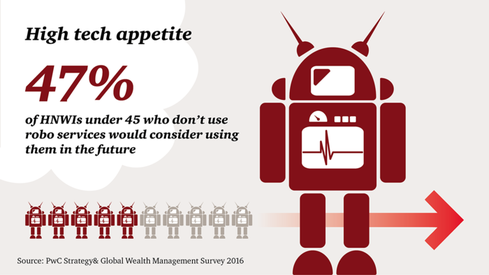
According to the report, what is currently on offer in the wealth-management industry is sharply at odds with what their clients, high net worth individuals (HNWIs), expect.

In her commentary on the report, PwC’s Olwyn Alexander said that the “sector is now acutely vulnerable to digital innovation from fin-tech newcomers, including robo-advice services” – and that firms that didn’t respond wouldn’t survive in the medium- to long-term.

1 Comment

Fintech: (1) UK FCA Sandbox, (2) Australian ASIC Sandbox and (3) Irish Central Bank Sandbox? by Peter Oakes 

6/5/2016

0 Comments

 
Picture
Spoiler alert, if you were hoping for an announcement of an Irish ‘sandbox’ to join the UK FCA and the Aussie ASIC sandboxes in yesterday's (05 May 2016) fintech speech by the Central Bank, you’ll be disappointed.  

The word ‘sandbox’ is like the word ‘sex’; if you put it in the heading of a fintech article, you're sure to get attention.

There is no indication that the Irish Central Bank is thinking of a sandbox or an innovation hub from today’s speech by Bernard Sheridan (Central Bank Director of Consumer Protection).  However nothing in the speech reads to me that the Central Bank will not go down that path.  The tone of the speech is very open and cautious, leaving the Central Bank room to manoeuvre (or pivot as we say in industry) as it responds to the challenges of fintech and, in the case of this speech, consumer protection risk.  We might expect a prudential driven fintech speech in the future as the areas of financial stability and market conduct area the  focal point of other Directors at the Central Bank.  

At a speech given at the Financial Services Innovation Centre in the Cork yesterday, the senior central banker commenced by saying he ‘was struck by the growing and significant level of interest there is in fintech developments across a wide variety of sources including international regulatory bodies’ and it being ‘a clear sign of things to come’ for regulated and non-regulated fintech firms.  Reference was made to a number of Mr Sheridan’s international peers, including;

  • Mark Carney, Chair of the Financial Stability Board: global regulators are evaluating potential stability implications that emerging financial technology poses to the global financial system including “systemic implications of financial technology innovations and the systemic risks that may arise from operational disruptions”.
  • European Commission: “the retail financial services sector is experiencing significant change as it is affected by digitalisation. New business models are emerging: online-only providers and technology companies are entering the market, offering services (within Member States and sometimes cross-border) including electronic money transfers, intermediation in online payments, financial data aggregation, peer-to-peer funding and price comparison”.
  • Steven Maijoor, Head of EIOPA: “financial innovation is important and, at its best, contributes to economic growth. However, this can only be achieved and sustained where consumers have confidence in such innovations. Our role as European Supervisory Authorities is to monitor new financial activities and to take action where appropriate.”

Returning to Ireland, the regulator noted that its strategic plan has identified the increased risks arising from technological developments and the increased reliance on information technology by regulated firms, their customers and suppliers. He also reminded that cyber risk is a key emerging threat and that the regulator’s Consumer Protection Outlook Report highlighted financial innovations as a key consumer risk - “[t]he consumer benefits of accessibility and convenience must be matched by service reliability, safety and security, and transparency of cost of services”.

While I agree that the issue of financial stability risk arising through innovative financial services is important, this isn’t something new.  Rather it seems to me that regulators, even if they considered this to be an issue previously, may not have had the confidence to express their concerns until recently.  It feels like regulators have been driven out of their comfort zone and forced to confront the rapid (re)evolution in industries which they traditionally pondered about for years, if not decades, before setting out their prudential, consumer and conduct risk concerns.  While it is a fair observation to note that “Fintech is transcending traditional boundaries and borders, not just physical but also regulatory as it blurs the lines between regulated and unregulated activities”, this is nothing new.  The same can be said of banking and investment house conglomerates which run empires of regulated and unregulated firms, to which the same tests are applicable as to whether they are regulated or not.  A significant problem in the world of fintech are the inconsistent interpretations across the EU.  For example, peer-to-peer lending is considered to fall under the Payment Services Directive in Germany and Italy, but the same activity in Ireland is not.  This has nothing to do with the fact that the activity is provided through fintech or not.

The regulator goes on to note that “As new technologies change the everyday provision and delivery of financial services for consumers and firms, it becomes more challenging for regulators to monitor what is going on as the regulatory rulebooks and supervisory tools struggle to keep pace with developments.” Quite frankly, I don’t understand why it becomes more challenging for regulators unless they remain static and continue with outdated and backward looking supervisory systems instead of real-time and data analytic supervisory systems.  The information which they need to keep abreast of is rapidly moving to digital format.  They have a number of options here: (1) insist on being provided access to this data direct, which is what fintech firm Uphold Inc voluntarily does, by providing real time transaction data to the regulators; (2) ramp up their own resources, i.e. technology, understanding of data analytics, AI, staff and education; and (3) try to stop the advancement so that it remains at a level at which regulators are capable of supervising - but good luck with regulating the internet!

Consumer protection and the Central Bank
As we know, the Central Bank has a statutory objective of effective regulation of financial service providers and markets, while ensuring that the best interests of consumers are protected. And it is fair for the regulator to let us know its thinking that the disruptive impact of financial innovation is impacting on its risk priorities and the way it does its work. The regulator noted that “[f]intech certainly has the potential to bring many benefits for firms and consumers and the framework should protect the consumer’s best interest and enable the management of additional and new risks by firms while not stifling innovation or damaging consumers’ trust and confidence in financial services”.  This sounds impressive until one asks exactly what are the precise ‘risks’ which are of concern to the local and overseas regulators? Saying general that there are risks to financial stability and consumer protection simply because change is afoot does not help inform the debate.

In the eyes of the Irish regulator a few of the areas where fintech and innovation are impacting on its consumer protection work include: (1) monitoring of consumer risks; (2) authorisation process for new firms; (3) new product development; and (4) how we are changing our approach to assessing consumer risks in firms. Noting that point 4 mitigates point 1, there are really only 3 areas here.

1. Monitoring of emerging risks
Under this heading the regulator noted that the findings from its consumer focus groups included people being “time poor”, people wanting more convenient and less time consuming complaints processes, including online channels for formal complaints. I get this point, but I am at a loss as to why this “presents a real challenge as to how innovation can be utilised better to marry the two consumer needs i.e. having a convenient and easy to use complaints process while at the same time enabling interaction with an experienced member of staff to resolve complaints in a fair, timely and transparent way”.  Surely the advent of online and ‘direct to supplier’ chat support forums on many of today’s websites is the starting point.  This is not an issue about the channels available to consumers, but rather the quality of the interaction and therefore the resolution of a complaint?  

I liked the next part of the speech.  I think it was meant to provide comfort, but will probably spook those who feel that we live in an Orwellian society – “The Central Bank also undertakes regular social media monitoring and gathers intelligence from platforms such as social media sites, public discussion fora and media sources in order to gain an insight into and keep abreast of current issues being raised by consumers”.  One suspects that monitoring might also focus on the behaviour of regulated firms in cyber space too.

We learn in the speech that the European Supervisory Authorities (“ESAs”) accept that increased automation of advice to consumers provides potential benefits, such as wider access, lower cost and more consistent consumer experience.  And we also learn that the ESAs are concerned about potential risks, e.g. consumers’ understanding of the nature of the service, limitations or errors in the tools and/or algorithms used. The ESAs are now considering what specific regulatory or supervisory actions should be taken to mitigate consumer risk in automated advice.

2. Authorisation Process
There is nothing new under this heading.  We covered this area when the changes were announced.  In fact, these changes we announced following our engagement with the regulator back in 2015.  See our April 2015 update here and our May update here. Suffice to say that the regulator repeated its adoption of the three key principles: accessibility; transparency; and timeliness.  The Central Bank reminded that its role is not to act as advisers to potential applicants but rather to provide clarity and certainty by responding to applicants in an open and facilitative way.

3. New Product Development
From 2017 new guidelines will be in place for banks and payment institutions, which will be followed by other sectors over time.  These guidelines will be a key part of the overall consumer protection framework. Product oversight and governance arrangements are to be an integral part of the firm’s governance, risk management and internal control framework requiring firms, amongst other things, to identify the target market, test products before launch, monitor how the product is performing and take remedial action where problems arise. Product testing will be required to enable the firm to “assess how the product would affect its consumers under a wide range of scenarios, including stressed scenarios”.  Product monitoring will be required on an on-going basis.

4. Assessing Consumer Protection Risks
Under the last heading the Central Bank announced that it is developing its Consumer Protection Risk Assessment supervisory model which will assess how firms are utilising technology to support their consumer risk management including:

  • how systems are used to alert firms to emerging and existing consumer risks;
  • how firms consider consumer risk management and reporting when developing new systems;
  • the maturity of firms’ analytics techniques in terms of identifying and escalating emerging and crystallised consumer risks.
The regulator noted that technological innovation can enable firms to deliver an effective internal consumer protection risk model and management information and support the delivery of suitable products and services. Looks like regtech to me.

Future Challenges

In his concluding remarks Bernard Sheridan said that there was potential for:

(i) a greater level of engagement between innovators, innovation centres and regulators so that we can all be better informed and involved in helping avoid the crystalisation of consumer protection risks in new innovations;
(ii) at a firm level, there is an opportunity for fintech to play a bigger part in developing products and services that help support regulated firms in monitoring and managing consumer risks;
(iii) at the product level, fintech can bring forward innovative solutions for firms seeking to deliver suitable consumer-focused products and services and support firms meeting their regulatory requirements in product oversight and governance;
(iv) and finally, at the consumer level, fintech can help deal with the issue of product complexity and the increasing difficulties that consumers are having in understanding financial products and services.

His final words on fintech and consumer protection were, unsurprisingly, “We all can and must play our part in ensuring that innovation and consumer protection are closely aligned and, above all, that we are continuously focused on getting it right for the consumer”.


0 Comments
<<Previous
Forward>>

    Author

    Fintech Ireland

    Archives

    December 2026
    June 2026
    May 2026
    March 2026
    December 2025
    October 2025
    September 2025
    July 2025
    March 2025
    February 2025
    January 2025
    December 2024
    November 2024
    October 2024
    July 2024
    June 2024
    May 2024
    April 2024
    March 2024
    February 2024
    December 2023
    November 2023
    October 2023
    September 2023
    August 2023
    July 2023
    June 2023
    May 2023
    April 2023
    February 2023
    October 2022
    July 2022
    June 2022
    April 2022
    March 2022
    January 2022
    December 2021
    July 2021
    May 2021
    April 2021
    March 2021
    February 2021
    January 2021
    November 2020
    October 2020
    September 2020
    August 2020
    July 2020
    April 2020
    February 2020
    July 2019
    April 2019
    March 2019
    February 2019
    January 2019
    October 2018
    September 2018
    July 2018
    June 2018
    May 2018
    April 2018
    March 2018
    January 2018
    October 2017
    September 2017
    August 2017
    July 2017
    June 2017
    May 2017
    March 2017
    January 2017
    December 2016
    November 2016
    September 2016
    August 2016
    July 2016
    June 2016
    May 2016
    April 2016
    March 2016
    February 2016
    December 2015
    September 2015
    July 2015
    June 2015
    May 2015
    April 2015
    March 2015
    September 2014
    January 2014

    Categories

    All
    Account Information Services
    AISP
    Anne Boden
    Authorisations
    #bankinginquiry
    Bank Of England
    Bitcoin
    Brian Fahey
    British Embassy Dublin
    Business Post
    CB Insights
    Central Bank Of Ireland
    Challenger Bank
    Chambers And Partners
    Competition And Consumer Protection Commission
    Compliance
    Consultations
    Contributor Articles
    Corporate Governance
    Crowdingfunding
    Crypto Assets
    Cryptocurrencies
    Currency Fair
    Cyber Security
    DeFi
    Department Of Finance
    Digital Assets
    Digital Euro
    Digital Wallets
    Directors Duties
    Disruption
    Dogpatch Labs
    Electronic Money
    EML Payments
    EMoney
    European Commission
    Financial Literacy
    Fintech
    Fintech Abu Dhabi
    Fintech Hub
    Fintech Ireland
    Fintech Ireland Map
    Fintech Ireland Summit
    Fintech Leaders Series
    Funding
    Funds
    Gemini
    Ifs2020
    Ifsc
    Innovation
    International Financial Services Strategy
    Ireland For Finance
    Irish Fintech Companies
    John Berrigan
    Kraken
    Mairead McGuiness
    Marketplace
    MiCA
    Mifid
    Moneycorp
    Money Laundering
    Monzo Bank
    MoonPay
    MyComplianceOffice
    Neobanks
    Newsletter
    Nuapay
    @oakeslaw
    OFX Payments
    Paschal Donohue
    Payments
    Payments Institution
    Paysafe
    Payward
    Peer To Peer
    Peer-to-peer
    Realex Payments
    Regtech
    Regulated Fintech
    Regulation
    Roboadvisers
    Robo Advisors
    Robo-advisors
    Ronan Gallagher
    RTE
    Sandbox
    Sentenial
    Simon Harris
    Square
    SquareUp International
    Stablecoins
    Starling Bank
    Strategy
    SYNC Payments
    The Project Foundry
    TransferMate
    Unicorn
    Unicorns
    USA Today
    Virtual Assets
    Wealthtech
    Zodia Custody
    Zodia Markets

©Fintech Ireland and ©Fintech.  Fintech Ireland (523657) and Fintech (523656) are registered with the Companies Registration Office in Ireland
www.fintechireland.com / www.fintechireland.ie / www.irishfintech.ie / www.irishfintech.com / www.fintechcareers.ie
Privacy Policy